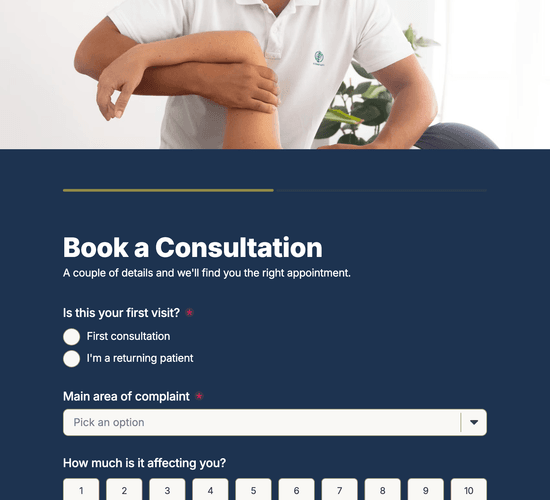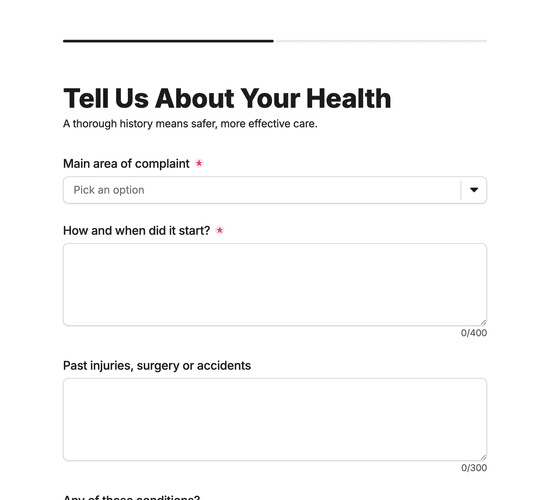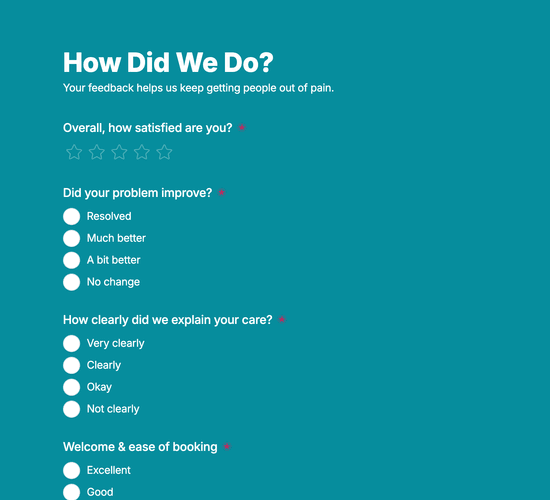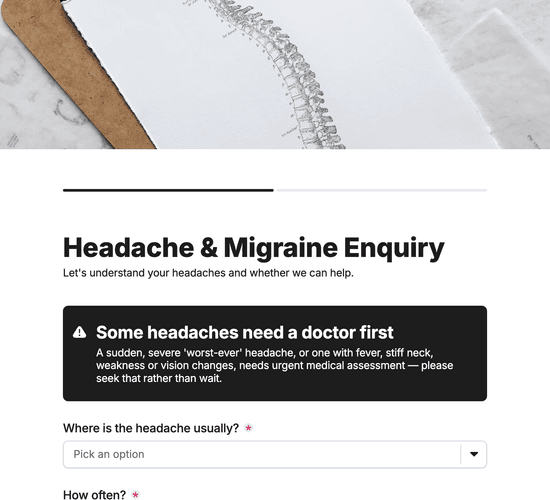
Create & Publish
 35+ Form Fields
Build the perfect form in a few clicks and drags.
 Conditional Logic
Build forms that adapt to each user's answers.
 E-Signatures
Collect digital signatures directly in your forms.
 Share Form Links
Each form you create generates a unique URL for easy sharing.
 Embed Your Form
Embed your form anywhere that supports HTML.
 Live Preview
Preview and test your form as you build it, without affecting your live form.
 Offline Recovery
Automatically restore form data after connection loss or page refresh.
Branding & Personalization
 70+ Theme Library
Start with a beautiful theme, then make it completely your own.
 Custom Themes
Fully customize your form's design and reuse it across all your forms.
 Cover Photo
Add a custom cover photo or color to the top of your form.
 Logo Branding
Add your own logo to your forms, emails and PDF results.
 Custom Social Share
Customise how your form appears when its link is shared.
 Custom Redirect
Redirect to your own thank you URL after form submission.
 Custom Favicon
Add your own favicon to your form's browser tab.
Sending & Configuration
 Custom Domains
NEW
Send autoresponders from your own domain.
 PDF Results
Automatically generate branded PDFs from your form results.
 Autoresponders
NEW
Send automatic replies to form respondents.
Results & Management
 Results Dashboard
View, manage and export every form result from one place.
 Project Folders
Organize your forms into projects for easier management.
 Project Members
Invite other users to your projects and build forms together.
Unlimited everything.
Build unlimited forms, collect unlimited results, and use unlimited templates — all for free.

By industry
 Legal Services
One home for every legal services form — conveyancing, family law, immigration and more, ready to customize.
 Real Estate
One home for every real estate form — commercial property, estate agents, lettings & property management and more, ready to customize.
 Healthcare
One home for every healthcare form — care homes, dental practices, gp & medical practices and more, ready to customize.
 Fitness
One home for every fitness form — calisthenics, climbing, crossfit and more, ready to customize.
 Beauty
One home for every beauty form — barbering, hair salon, lashes & brows and more, ready to customize.
 Construction
One home for every construction form — bricklaying & masonry, carpentry & joinery, demolition and more, ready to customize.
 Hospitality
One home for every hospitality form — holiday rentals, hotels & b&bs, resorts & holiday parks and more, ready to customize.
By type
Contact Forms Make it easy to reach you — customizable contact forms for any site. Booking Forms Take bookings 24/7 — customizable forms your customers can submit anytime. Registration Forms Register people fast — events, courses and programs, ready to customize. Application Forms Collect applications of any kind — jobs, memberships, programs and more. Feedback Forms Hear what people think — customizable feedback forms for any audience. Lead Forms Fill the pipeline — lead-capture forms you can embed anywhere. Survey Forms Ask the right questions — customizable surveys for any audience.Popular
Contact Form Route customer inquiries cleanly — reason, urgency and account — so messages reach the right team and get the right response. Lead Capture Form Turn social media interest into leads — service, needs and contact details — captured the moment someone’s curious. Event Registration Form Register attendees for your non-profit events online, capturing contact details, dietary needs, and volunteer interest in one friendly form. Appointment Request Form Let patients request an appointment online — preferred date, time, type and reason — so your front desk can book it fast. Job Application Form Take job applications with one clean form — contact, role, resume, availability and eligibility — ready to shortlist. Customer Feedback Form Gather customer feedback on their store visit — satisfaction, what worked and any issues — so you keep shoppers coming back. Membership Signup Form Sign up new members to your community group online, capturing contact details, membership type, and consent in one tidy form.Start from a template.
Every one is free, fully customizable and ready to embed — make it yours in minutes.







Missing an app?
Pipe submissions to 6,000+ apps with Zapier, or hit any endpoint using webhooks.
Manual Therapy & Adjustment Consent Form
A treatment-consent template for chiropractic and osteopathy clinics — the techniques, risks and consent captured, so treatment proceeds with informed agreement.
Description
Form fields
Everything the Manual Therapy & Adjustment Consent Form above collects — 6 fields, so you can see exactly what it captures before you make it your own.
Treatment Consent
Any questions before we begin?
Long Answer

Please confirm you understand
Multi-Select
I consent to manual therapy and adjustment
Consent
Your name
Name
Date of birth
Email address

 No credit card
-
Unlimited forms
-
Unlimited results
Template FAQs
Common questions about the Manual Therapy & Adjustment Consent Form — what it captures, when to use it, and how to make it your own.
What is informed consent for chiropractic treatment?
It’s confirming you understand the treatment — the techniques, the likely after-effects and the rare risks — and agree to go ahead. Chiropractors and osteopaths are required to obtain it. This form records that your practitioner has explained treatment and you consent to proceed.
What should a treatment consent form include?
The techniques that may be used, the common mild after-effects, the rare risks the practitioner must disclose, and your informed consent with a chance to ask questions. This form captures all of it so treatment proceeds on a clear, agreed footing.
What are the common after-effects of treatment?
Some patients feel temporary soreness, stiffness or tiredness for a day or two after treatment, much like after exercise — this is common and usually settles. The form explains this so you know what’s normal and when, rarely, to get back in touch.
Why do I need to consent each care plan?
Because consent should be informed and ongoing — you’re entitled to understand and agree what’s proposed, and to change your mind at any time. Recording consent at the start of care confirms the techniques and risks were explained and protects both you and the practitioner.
Can I ask questions before consenting?
Absolutely — and you should. The form includes space to raise anything, and your practitioner will talk you through the techniques, after-effects and risks before you sign. Consent only means something if you’ve had the chance to understand and ask.
Is the consent form free?
Yes — the form is free with a Fun Forms account, fully customizable to your clinic, and it embeds on your website or shares as a link, with no coding needed.
-
No credit card
-
Unlimited forms
-
Unlimited results