Create & Publish
 35+ Form Fields
Build the perfect form in a few clicks and drags.
35+ Form Fields
Build the perfect form in a few clicks and drags.
 Conditional Logic
Build forms that adapt to each user's answers.
Conditional Logic
Build forms that adapt to each user's answers.
 E-Signatures
Collect digital signatures directly in your forms.
E-Signatures
Collect digital signatures directly in your forms.
 Share Form Links
Each form you create generates a unique URL for easy sharing.
Share Form Links
Each form you create generates a unique URL for easy sharing.
 Embed Your Form
Embed your form anywhere that supports HTML.
Embed Your Form
Embed your form anywhere that supports HTML.
 Live Preview
Preview and test your form as you build it, without affecting your live form.
Live Preview
Preview and test your form as you build it, without affecting your live form.
 Offline Recovery
Automatically restore form data after connection loss or page refresh.
Offline Recovery
Automatically restore form data after connection loss or page refresh.Branding & Personalization
 70+ Theme Library
Start with a beautiful theme, then make it completely your own.
70+ Theme Library
Start with a beautiful theme, then make it completely your own.
 Custom Themes
Fully customize your form's design and reuse it across all your forms.
Custom Themes
Fully customize your form's design and reuse it across all your forms.
 Cover Photo
Add a custom cover photo or color to the top of your form.
Cover Photo
Add a custom cover photo or color to the top of your form.
 Logo Branding
Add your own logo to your forms, emails and PDF results.
Logo Branding
Add your own logo to your forms, emails and PDF results.
 Custom Social Share
Customise how your form appears when its link is shared.
Custom Social Share
Customise how your form appears when its link is shared.
 Custom Redirect
Redirect to your own thank you URL after form submission.
Custom Redirect
Redirect to your own thank you URL after form submission.
 Custom Favicon
Add your own favicon to your form's browser tab.
Custom Favicon
Add your own favicon to your form's browser tab.Sending & Configuration
 Custom Domains
NEW
Send autoresponders from your own domain.
Custom Domains
NEW
Send autoresponders from your own domain.
 PDF Results
Automatically generate branded PDFs from your form results.
PDF Results
Automatically generate branded PDFs from your form results.
 Autoresponders
NEW
Send automatic replies to form respondents.
Autoresponders
NEW
Send automatic replies to form respondents.Results & Management
 Results Dashboard
View, manage and export every form result from one place.
Results Dashboard
View, manage and export every form result from one place.
 Project Folders
Organize your forms into projects for easier management.
Project Folders
Organize your forms into projects for easier management.
 Project Members
Invite other users to your projects and build forms together.
Project Members
Invite other users to your projects and build forms together.Unlimited everything.
Build unlimited forms, collect unlimited results, and use unlimited templates — all for free.

By industry
 Legal Services
One home for every legal services form — conveyancing, family law, immigration and more, ready to customize.
Legal Services
One home for every legal services form — conveyancing, family law, immigration and more, ready to customize.
 Real Estate
One home for every real estate form — commercial property, estate agents, lettings & property management and more, ready to customize.
Real Estate
One home for every real estate form — commercial property, estate agents, lettings & property management and more, ready to customize.
 Healthcare
One home for every healthcare form — care homes, dental practices, gp & medical practices and more, ready to customize.
Healthcare
One home for every healthcare form — care homes, dental practices, gp & medical practices and more, ready to customize.
 Fitness
One home for every fitness form — calisthenics, climbing, crossfit and more, ready to customize.
Fitness
One home for every fitness form — calisthenics, climbing, crossfit and more, ready to customize.
 Beauty
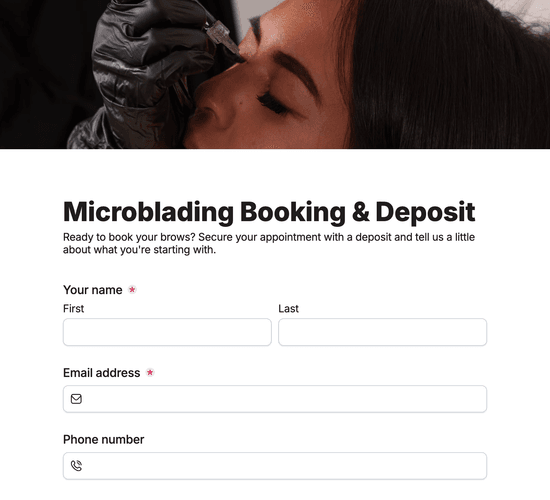
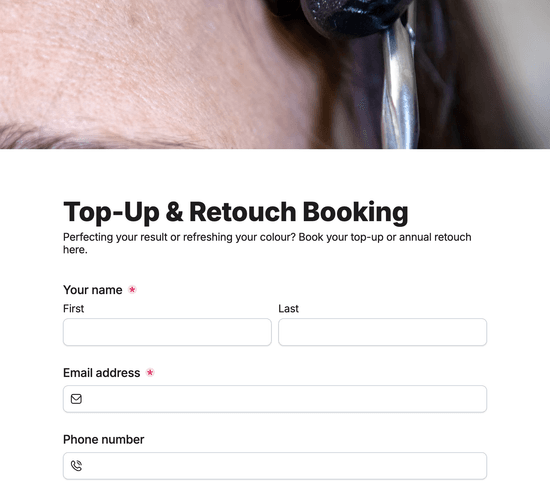
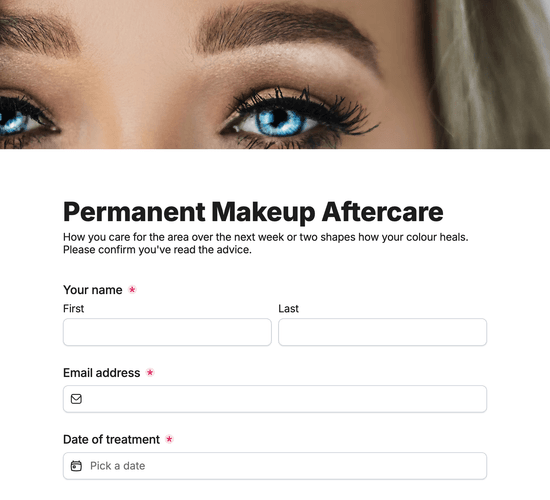
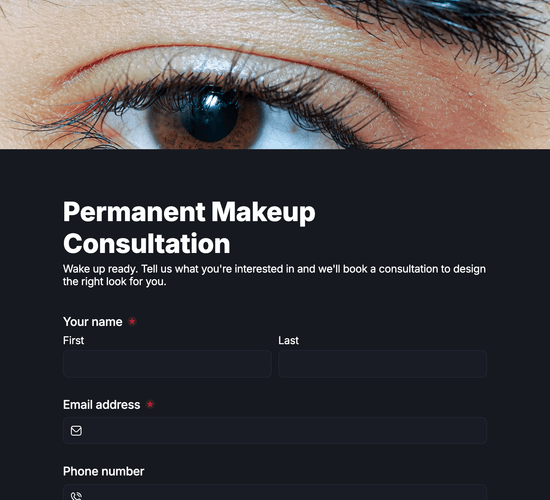
One home for every beauty form — barbering, hair salon, lashes & brows and more, ready to customize.
Beauty
One home for every beauty form — barbering, hair salon, lashes & brows and more, ready to customize.
 Construction
One home for every construction form — bricklaying & masonry, carpentry & joinery, demolition and more, ready to customize.
Construction
One home for every construction form — bricklaying & masonry, carpentry & joinery, demolition and more, ready to customize.
 Hospitality
One home for every hospitality form — holiday rentals, hotels & b&bs, resorts & holiday parks and more, ready to customize.
Hospitality
One home for every hospitality form — holiday rentals, hotels & b&bs, resorts & holiday parks and more, ready to customize.By type
Contact Forms Make it easy to reach you — customizable contact forms for any site. Booking Forms Take bookings 24/7 — customizable forms your customers can submit anytime. Registration Forms Register people fast — events, courses and programs, ready to customize. Application Forms Collect applications of any kind — jobs, memberships, programs and more. Feedback Forms Hear what people think — customizable feedback forms for any audience. Lead Forms Fill the pipeline — lead-capture forms you can embed anywhere. Survey Forms Ask the right questions — customizable surveys for any audience.Popular
Contact Form Route customer inquiries cleanly — reason, urgency and account — so messages reach the right team and get the right response. Lead Capture Form Turn social media interest into leads — service, needs and contact details — captured the moment someone’s curious. Event Registration Form Register attendees for your non-profit events online, capturing contact details, dietary needs, and volunteer interest in one friendly form. Appointment Request Form Let patients request an appointment online — preferred date, time, type and reason — so your front desk can book it fast. Job Application Form Take job applications with one clean form — contact, role, resume, availability and eligibility — ready to shortlist. Customer Feedback Form Gather customer feedback on their store visit — satisfaction, what worked and any issues — so you keep shoppers coming back. Membership Signup Form Sign up new members to your community group online, capturing contact details, membership type, and consent in one tidy form.Start from a template.
Every one is free, fully customizable and ready to embed — make it yours in minutes.











Missing an app?
Pipe submissions to 6,000+ apps with Zapier, or hit any endpoint using webhooks.
Microblading & PMU Patch Test Consent Form
A PMU patch test template — records the test of pigment and anaesthetic and the client’s skin response before treatment.
Description
Form fields
Everything the Microblading & PMU Patch Test Consent Form above collects — 9 fields, so you can see exactly what it captures before you make it your own.
Microblading & PMU Patch Test
Your name
Name

Email address

Phone number
Telephone
Date of patch test
Date
What was tested (pigment / anaesthetic)
Short Answer
Did you notice any reaction within 24–48 hours?
Yes/No
If yes, please describe the reaction
Long Answer
Proceeding
Consent
Healing
Consent
 No credit card
-
Unlimited forms
-
Unlimited results
Template FAQs
Common questions about the Microblading & PMU Patch Test Consent Form — what it captures, when to use it, and how to make it your own.
Why is a patch test needed before PMU?
Because permanent makeup uses pigments and often a topical anaesthetic, and some people react to one or the other. A patch test before treatment catches a sensitivity before pigment is implanted.
What's tested?
The pigment and the anaesthetic to be used, applied to a small area. The form records what was tested and whether any reaction appeared within 24–48 hours.
Why mention healing and fading in the consent?
Because PMU colour heals softer than it looks at first, fades over time, and needs a top-up — which clients often don’t expect. Setting that expectation early prevents worry during healing.
What if the client reacts to the patch test?
There’s a box to describe the reaction, and the consent to proceed only applies if none occurred. A reaction means finding an alternative pigment or anaesthetic, or advising against treatment.
Does it replace the full treatment consent?
No — it’s the patch-test record. A full treatment consent form is completed before the appointment itself.
Is the template free?
Yes. It’s free with a Fun Forms account, fully brandable, and ready to complete on a tablet or via a link.
-
No credit card
-
Unlimited forms
-
Unlimited results